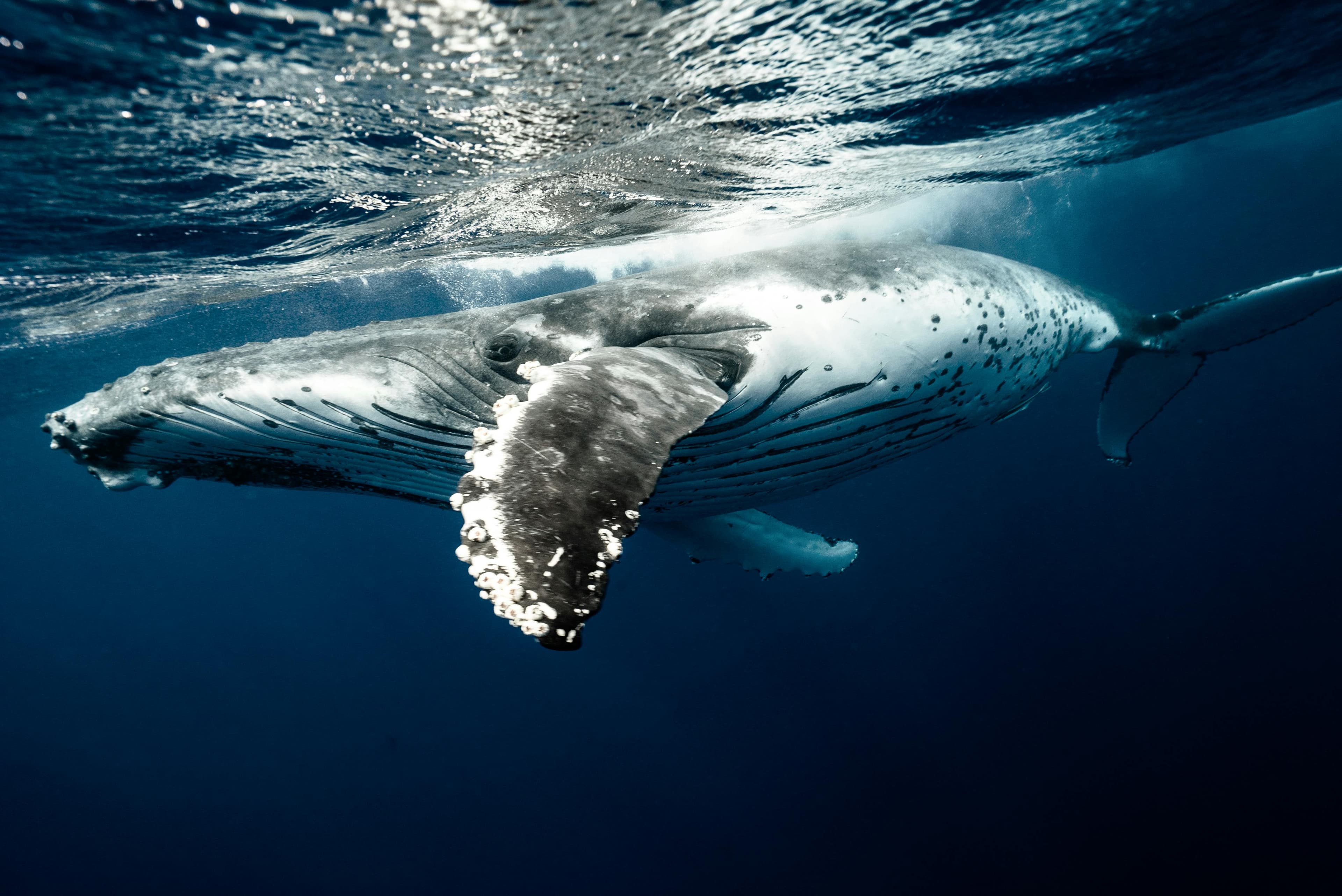
Overview
Whales are the largest animals on Earth and members of the order Cetacea. They are highly social, forming complex family groups and cultural communities that persist across generations. Species like humpback, sperm, and orca whales are known for their extraordinary intelligence and emotional depth. Their evolutionary history stretches back 50 million years, and their land-dwelling ancestors returned to the sea — a transition that shaped one of the most specialised brains in the natural world.
Brain Anatomy
Whales have large brains with advanced limbic systems — potentially linked to complex emotions, deep empathy, and social bonding. The sperm whale holds the record for the largest brain of any animal ever known, weighing up to 9 kg. Humpback whales possess specialised neurons called von Economo neurons (spindle cells) — previously thought to be unique to great apes and humans — which are associated with social cognition, self-awareness, and rapid intuitive decision-making. Cetacean brains also show high gyrification (cortical folding), dramatically increasing the surface area available for neural processing.
Behaviour & Intelligence
Humpback whale songs evolve culturally — new melodies emerge and spread westward across populations like viral hit songs, with individuals learning and adopting the latest 'trends.' Orcas have distinct dialects passed down through maternal family lines across generations. Sperm whales live in matriarchal family units and pass complex foraging strategies to their young through cultural transmission. Evidence suggests some whale species grieve their dead — mothers have been observed carrying deceased calves for days. Orcas have been documented teaching their young to strand on beaches to catch sea lions — a learned hunting technique unique to specific populations.
Did you know
The blue whale's brain weighs around 7 kg despite the animal weighing 150 tonnes — a tiny proportion by body mass. Yet sperm whales hold the record at 9 kg. Blue whale vocalisations — the loudest sounds made by any animal — can reach 188 decibels and travel over 1,600 km through deep ocean channels.