Overview
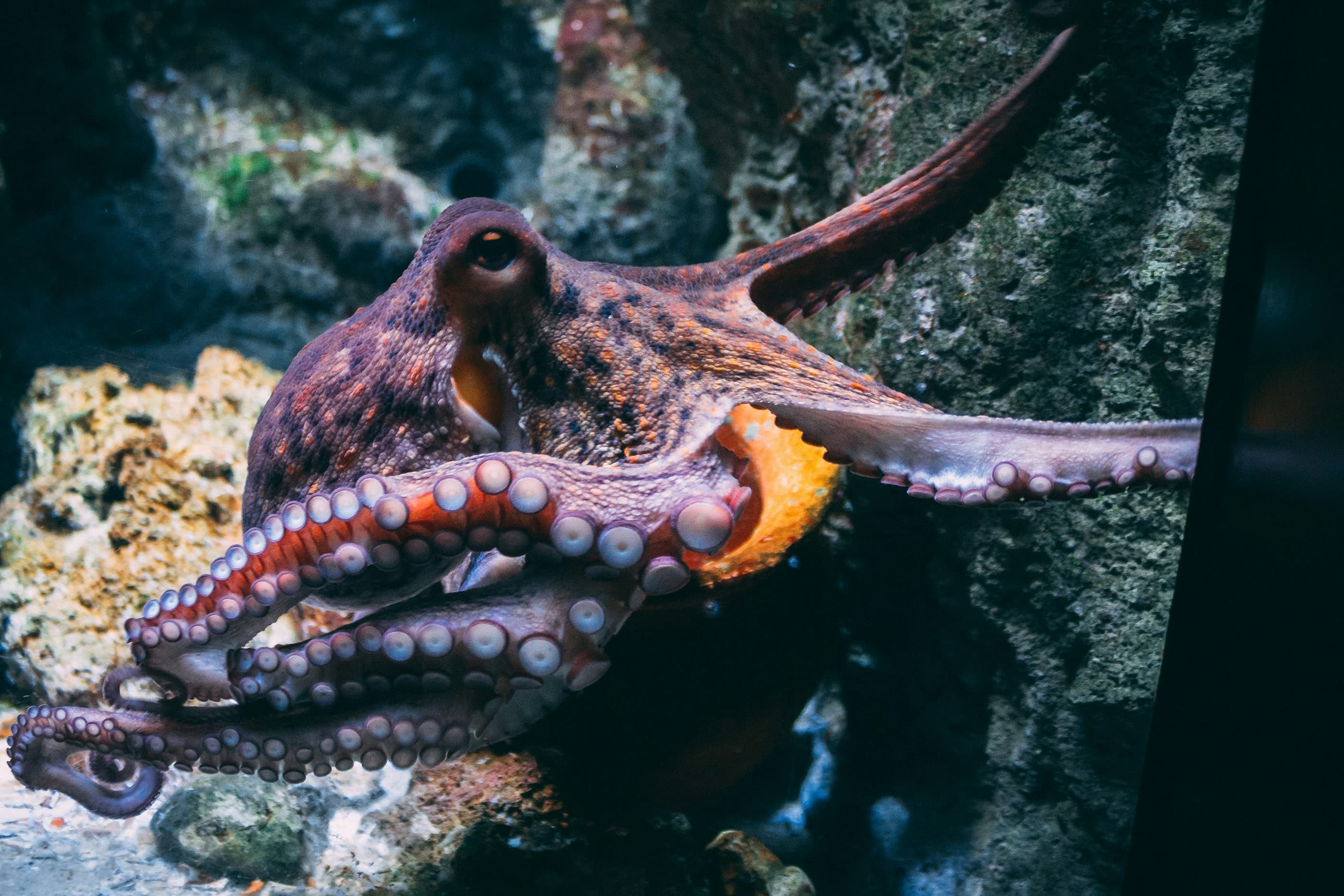
Octopuses are cephalopod mollusks with eight flexible arms lined with suckers capable of tasting and smelling what they touch. They are solitary, short-lived creatures with remarkable problem-solving abilities. Despite a lifespan of only 1–2 years, they demonstrate complex behaviours that rival those of much longer-lived vertebrates. They are the most cognitively advanced invertebrates on Earth, having evolved intelligence completely independently from vertebrates — a stunning case of convergent evolution.
Brain Anatomy
Two-thirds of an octopus's 500 million neurons are distributed throughout its eight arms — each arm contains its own neural cluster (ganglion) that processes sensory information and executes movements semi-independently, without constant input from the central brain. This gives them what scientists call a 'distributed intelligence.' The central brain forms a donut shape around the oesophagus, meaning food literally passes through the brain. They have highly developed optic lobes for processing complex visual information and can distinguish brightness, shape, and polarised light despite being colour-blind.
Behaviour & Intelligence
Octopuses can open child-proof jars, navigate mazes, use tools (coconut shells for portable shelters), recognise individual human faces, and escape from supposedly secure aquarium tanks — often returning before anyone notices. They have been observed playing, expressing curiosity, and showing distinct individual personalities. Their chromatophores — thousands of specialised skin cells — allow them to change colour, pattern, and texture in under a second for camouflage or communication. Mimic octopuses can impersonate other species like lionfish, flatfish, and sea snakes.
Did you know
Octopuses have three hearts and blue blood (copper-based haemocyanin instead of iron-based haemoglobin). When an octopus loses an arm, the severed arm can continue reacting to stimuli for up to an hour — the arm's local nervous system keeps it moving independently of the central brain.