Overview
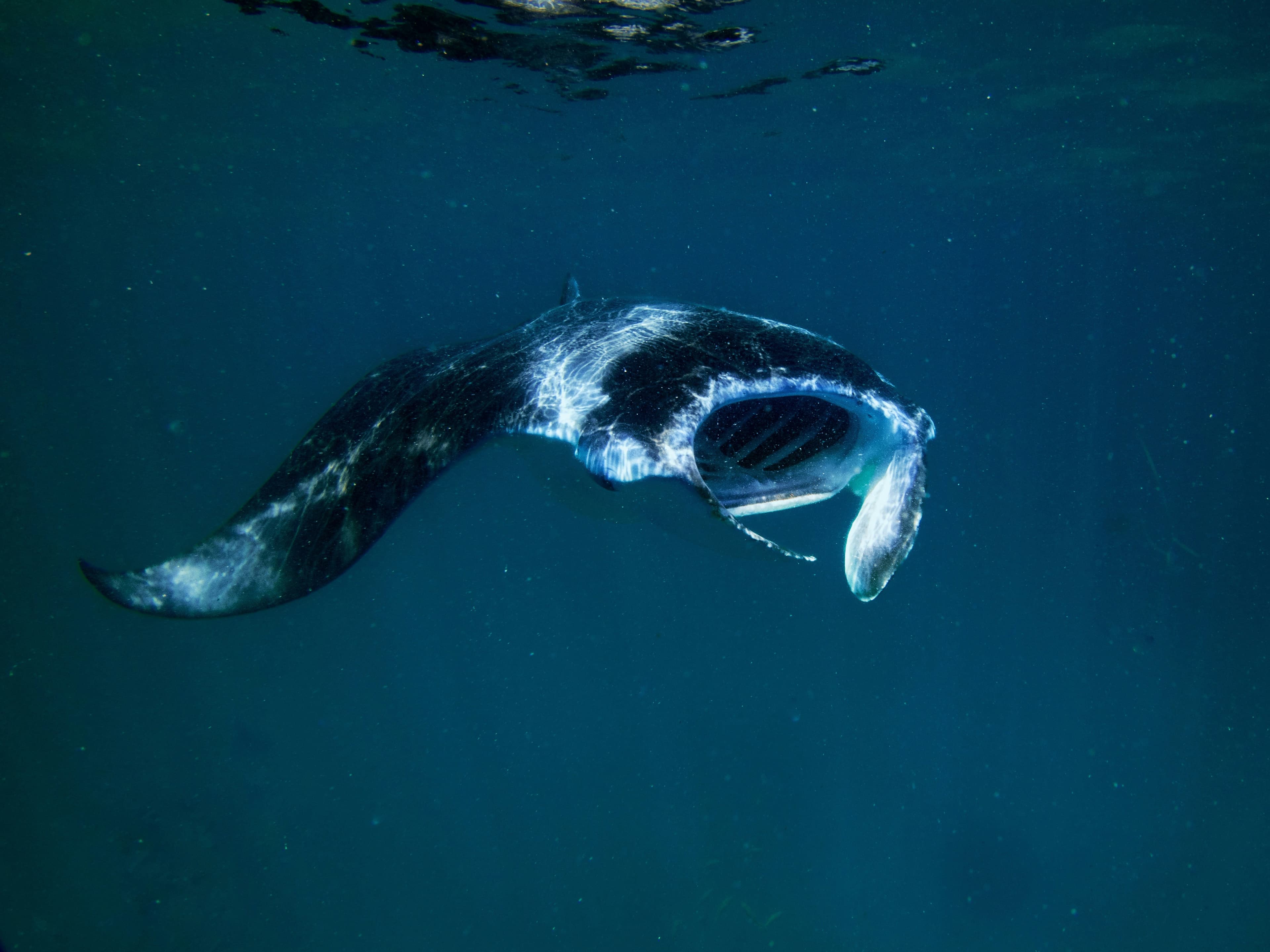
Manta rays are the largest rays in the ocean, with wingspans reaching up to 7 metres. Despite their size and their classification as fish, they demonstrate cognitive abilities that rival many mammals. They belong to the family Mobulidae and are closely related to sharks. Manta rays are filter feeders, consuming vast quantities of zooplankton, and undertake long ocean migrations following food sources across ocean basins.
Brain Anatomy
Manta rays possess the largest brain-to-body ratio of any fish and a significantly developed cerebellum — the brain region associated with fine motor control, coordination, and complex spatial awareness. Unlike most fish, their brains are warm — maintained at above-ambient temperatures through a specialised heat exchange system (rete mirabile) in the cranium. This thermal regulation may be critical to sustaining the metabolic demands of a larger, more complex brain in cold deep waters.
Behaviour & Intelligence
In 2016, researchers documented manta rays exhibiting contingent behaviour in front of mirrors — circling, examining unusual body parts, and blowing bubbles near their reflections — behaviours interpreted as mirror self-recognition. This places them alongside elephants, great apes, and dolphins as animals showing possible self-awareness. Manta rays also demonstrate long-term memory, returning to specific cleaning stations year after year, and exhibit curiosity toward divers, sometimes initiating play-like interactions.
Did you know
Manta rays visit dedicated 'cleaning stations' — coral reef sites where small fish like cleaner wrasses pick parasites from their bodies. They queue, wait their turn, and return to the same stations regularly. This learned social behaviour requires recognising specific locations across vast ocean migrations.